


The insurance and utilities industries sit at the heart of people’s daily lives, managing essential services such as policy premiums, electricity, water, and gas. Yet, behind the scenes, their financial operations face mounting challenges: rising transaction volumes, complex customer payment behaviors, fragmented payment channels, and the constant pressure to maintain liquidity. Traditional SAP Finance solutions like SAP FI-CA (Contract Accounting), SAP FS-CD (Collections and Disbursements), and SAP Convergent Invoicing (CI) have long provided robust frameworks to manage invoicing, collections, and bank reconciliation.
Now, the arrival of SAP Business AI is transforming these capabilities. By embedding machine learning, predictive insights, and intelligent automation into the SAP S/4HANA Finance backbone, insurers and utilities can unlock smarter payments, smarter collections, and a truly customer-centric financial experience.
This blog explores how AI, coupled with SAP BRIM and the SAP Integration Suite, is driving tangible business outcomes in payment processing, bank integration, dispute management, invoicing, clearing controls, and collections strategies reimagining financial operations in the SAP landscape.
Payment Processing & Bank Integration: Speed with Accuracy
Utilities and insurers handle millions of payments monthly, often coming from diverse channels: bank transfers, online portals, direct debit, credit cards, and third-party agencies. Even with advanced SAP payment processing and bank statement interpretation, a significant percentage of transactions land in clarification cases due to missing or ambiguous references.
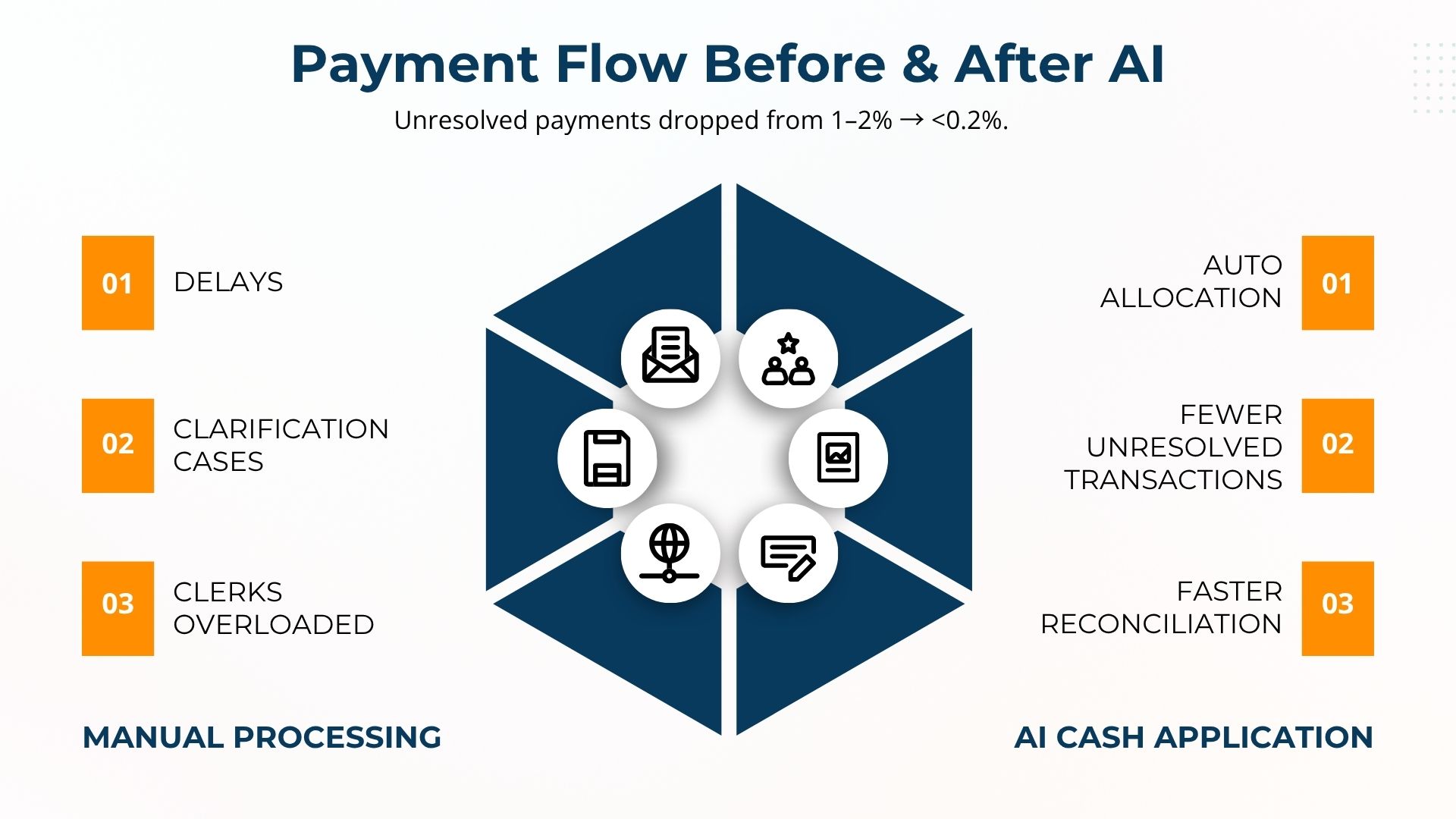
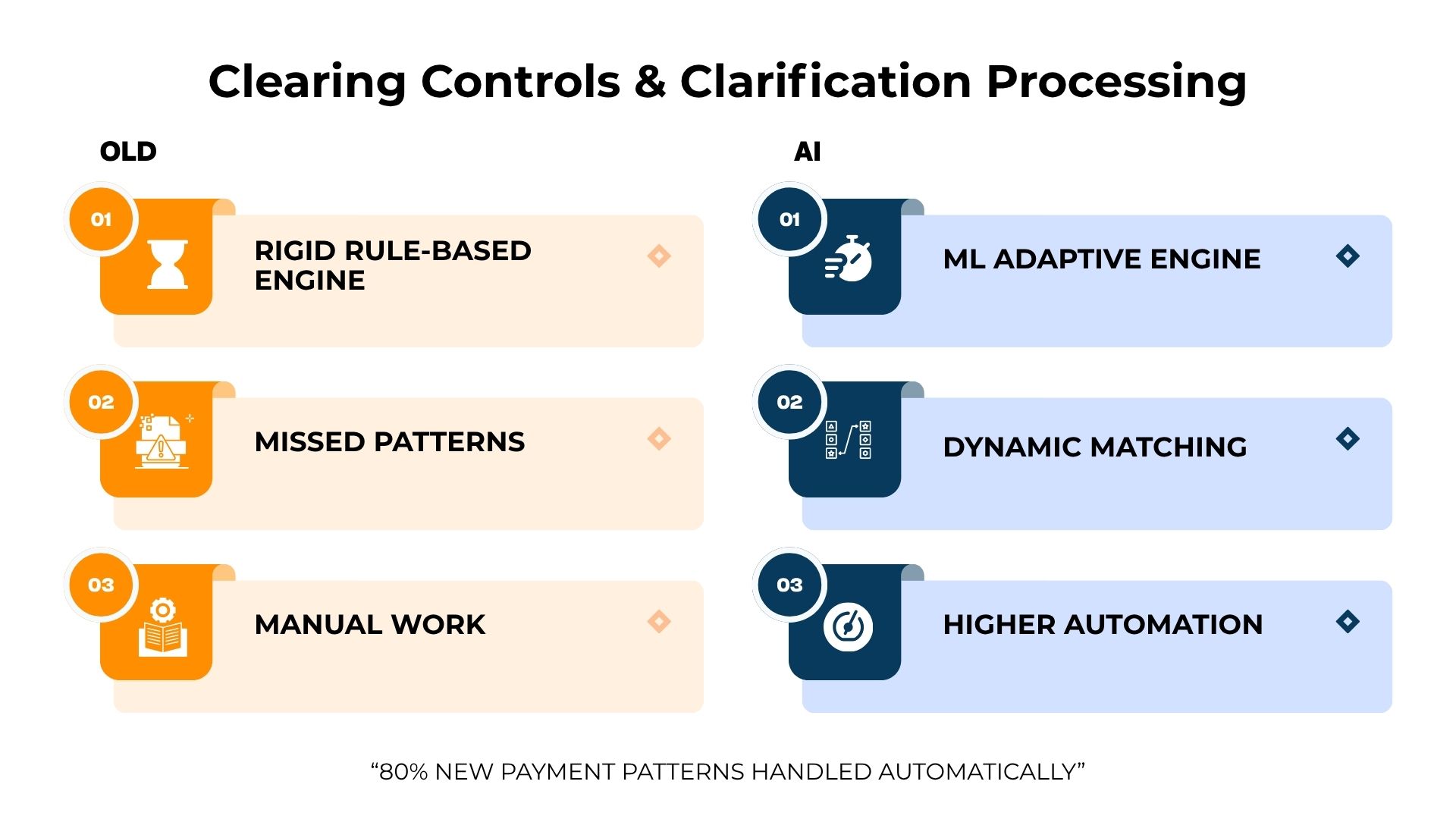
With AI-powered SAP Cash Application, payments are automatically allocated with high accuracy, learning continuously from past clearing actions. Machine learning models analyze remittance texts, reference fields, and payer behaviors to predict the right open receivables. At the same time, SAP Bank Integration enhanced with anomaly detection can flag duplicates, fraud risks, or mismatches between bank statements and SAP Financials records.
For example, an insurer receiving 500,000 daily premium payments cut unresolved transactions from 2% to just 0.2% after adopting AI-enabled FI-CA automation saving hundreds of work hours while accelerating revenue recognition.
Business outcome: faster reconciliation, reduced manual overhead, and stronger financial control.
Dispute & Clarification Management: From Hours to Minutes
Disputes and clarifications are costly, whether it’s a missing invoice reference, an incorrect contract account assignment, or customer disagreement. Delays impact renewals in insurance and disconnection decisions in utilities.
AI-powered SAP Dispute Management provides a consolidated view of invoice history, correspondence, payment records, and prior clarifications. Natural Language Processing (NLP) enhances the ability of agents to resolve issues quickly, while predictive models flag disputes likely to escalate into litigation or churn.
One utility provider reduced its average dispute resolution cycle from seven days to under 24 hours by using AI assistants integrated with SAP Consulting frameworks. The result was shorter cycles, fewer unresolved cases, and happier customers.
Business outcome: faster dispute resolution, fewer escalations, and improved customer satisfaction.
Invoicing with Convergent Invoicing: Intelligent Bill Management
Customers expect accurate, transparent, and timely billing. Errors can damage trust and trigger costly disputes. With SAP Convergent Invoicing embedded in SAP BRIM, firms can consolidate multiple services or policy types into a single invoice, whether it’s life insurance with add-ons or utilities bundling electricity, broadband, and water.
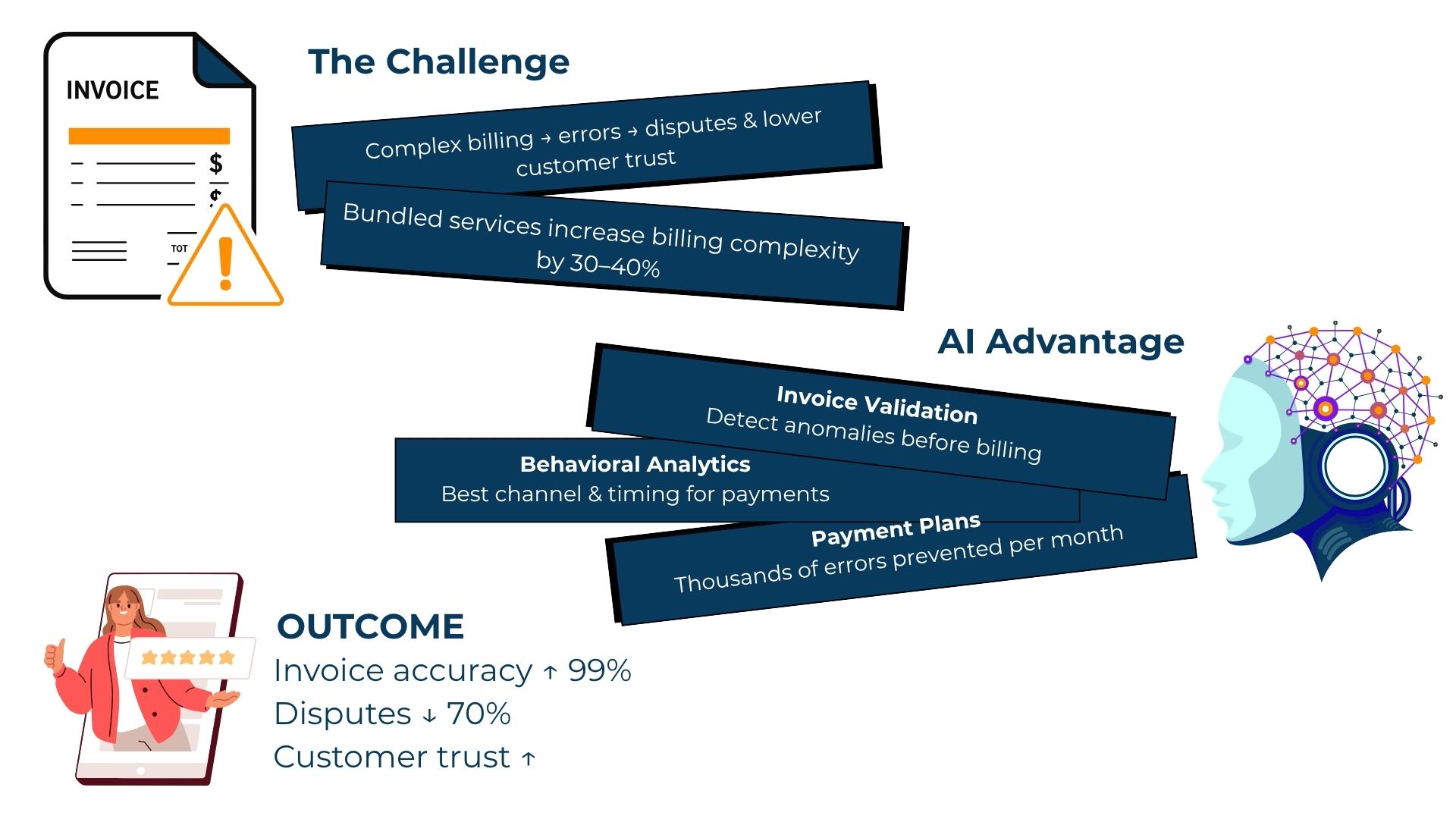
AI-driven validation engines scan invoices for anomalies such as outlier charges or missing discounts before they are sent. Behavioral analytics recommends optimal delivery channels and timing to improve payments on time. Flexible installment plans powered by SAP Revenue Accounting and AI increase affordability while reducing delinquency.
For instance, an insurer using AI within Convergent Invoicing detected and corrected policy migration errors before bills were issued, preventing thousands of incorrect invoices.
Business outcome: improved accuracy, reduced disputes, and greater customer trust.
Collections Strategy & Predictive Insights: Beyond Reactive Dunning
Traditional dunning processes often come too late eroding relationships without addressing the root cause of nonpayment. With SAP Collections Management, enhanced by AI, insurers and utilities can adopt predictive strategies that segment customers by risk.
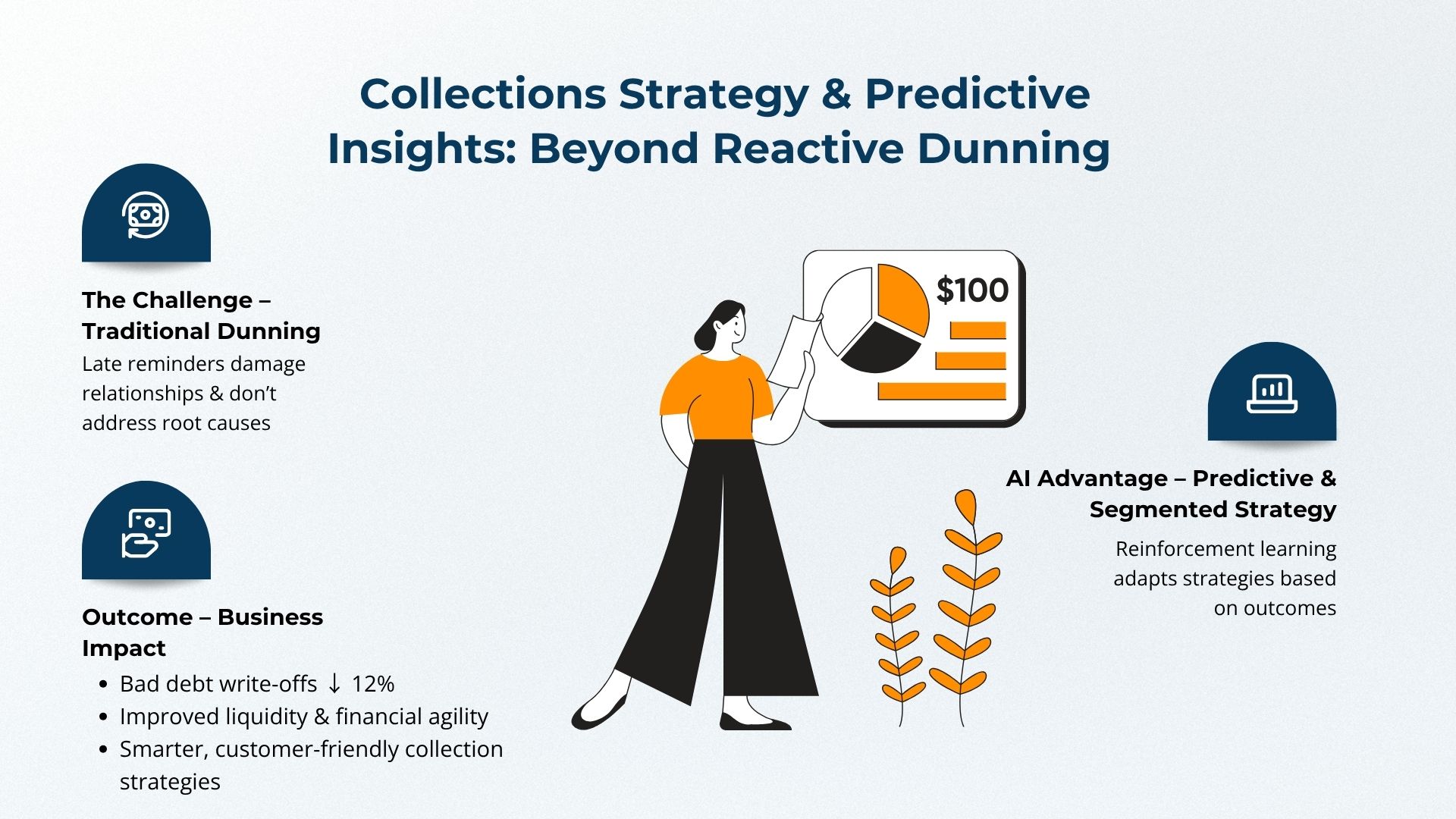
By integrating predictive insights with SAP PaPM (Profitability and Performance Management), firms can simulate collection scenarios and assess their impact on cash flow and compliance. High-risk customers can be engaged early with flexible plans, while low-risk customers may only need gentle reminders. Reinforcement learning further adapts strategies based on real outcomes.
A European energy provider reduced bad debt write-offs by 12% after adopting AI-driven collection strategies within SAP FI-CA and FS-CD, segmenting customers intelligently and applying differentiated tactics.
Business outcome: improved liquidity, reduced write-offs, and stronger financial agility.
Conclusion
Insurance and utilities firms operate in industries where trust and reliability are non-negotiable. By embedding AI into SAP FI-CA, FS-CD, SAP BRIM, and Convergent Invoicing, financial operations shift from being a back-office necessity to a strategic differentiator.
With SAP Clearing Control, AI-enhanced payment processing, dispute resolution, predictive collections, and real-time integration across SAP Financials, companies can achieve operational efficiency, better customer experiences, and sharper financial decision-making.
The winners in this era will not just digitize processes but reimagine them with SAP Business AI, turning finance into a true growth engine.
Frequently Asked Questions (FAQs)
How does SAP S/4HANA help insurance companies manage end-to-end policy and payment processes?
SAP S/4HANA Finance and Insurance modules integrate policy management, claims, commission, and reinsurance with financial control, enabling insurers to manage the entire lifecycle: from policy issuance to premium collection on a single digital core.
What is SAP BRIM and how is it relevant for insurance billing and invoicing?
SAP BRIM (Billing and Revenue Innovation Management) enables flexible, real-time billing and convergent invoicing for different types of insurance policies. It supports subscription-based, usage-based, and premium models, ensuring transparency and faster revenue recognition.
How does SAP FI-CA support insurance revenue management?
SAP FI-CA (Contract Accounts Receivable and Payable) is tailored for high-volume industries like insurance. It manages premium collections, reconciliations, payment failures, dunning reminders, and even integration with external collection agencies.
Can SAP Integration Suite connect insurers with payment engines in real time?
Yes. SAP Integration Suite seamlessly connects SAP FI-CA and SAP Convergent Invoicing with multiple payment engines, enabling flexible premium payment methods (cards, wallets, bank transfers, UPI, etc.) and ensuring real-time processing.
How can Artificial Intelligence improve insurance payment operations in SAP?
SAP Business AI enhances payment clarification, predicts payment defaults, automates dunning reminders, and supports reconciliation. This reduces revenue leakage, improves collection efficiency, and frees finance teams to focus on strategic decisions.
What kind of reporting and financial insights does SAP provide for insurers?
SAP Financials and SAP Clearing Control provide reconciliation reports, accounts receivable/payable tracking, and real-time cash visibility. This ensures CFOs and finance leaders maintain tighter financial control and compliance across operations.
Is SAP suitable for both large and mid-sized insurance firms?
Yes. With modular solutions like SAP S/4HANA Finance, SAP BRIM, and SAP Integration Suite, insurers of all sizes can adopt scalable best practices to improve collections, reduce costs, and enhance customer experience.

Looking for expertise and excellent know-how in matters of insurance & banking?
Mithlesh Kumar Jha
Managing Partner - SAP FPSL (Insurance & Banking)Highly skilled and experienced SAP Solution Architect with over 20 years of expertise in SAP finance transformation and system implementation. Proficient in SAP S/4HANA Finance, IS-U, BRIM, FI-CA, PAPM, FPSL, and SAP Analytics Cloud (SAC). Adept at designing and delivering end-to-end SAP solutions that align with business goals, enhance financial performance, and ensure regulatory compliance with IFRS17, Solvency II, US GAAP, and LDTI. Strong technical proficiency in ABAP, HANA modeling, BTP, and system integration. Demonstrated ability to lead cross-functional teams, manage complex projects, and drive business process optimization through innovative and scalable SAP solutions.