



A Practical Guide for CIOs and COOs Managing High-Volume Finance Operations
In highly regulated industries such as utilities, insurance, and telecom, compliance risk no longer sits at the edge of the organization waiting for audits or year-end reviews. It is embedded deep inside daily, high-volume financial operations billing runs, collections, clearing, write-offs, and revenue recognition executed at scale within SAP FI-CA.
For CIOs and COOs, this creates board-level exposure. Decisions made in FI-CA configuration, access design, and mass processing can quietly scale into material misstatements, regulatory findings, or revenue leakage long before issues surface in financial statements.
If your organization processes millions of customer accounts, operates across multiple legal entities, or runs automated mass activities daily, compliance management risk in SAP FI-CA is not theoretical it is operational.
Why Compliance Management Risk Is Higher in SAP FI-CA Landscapes
SAP FI-CA is a module purpose-built for mass transaction environments. Unlike traditional FI subledgers, it handles:
- Millions of customers and contract accounts
- Automated, repeatable mass activities
- Parallel processing across regulatory regimes and legal entities
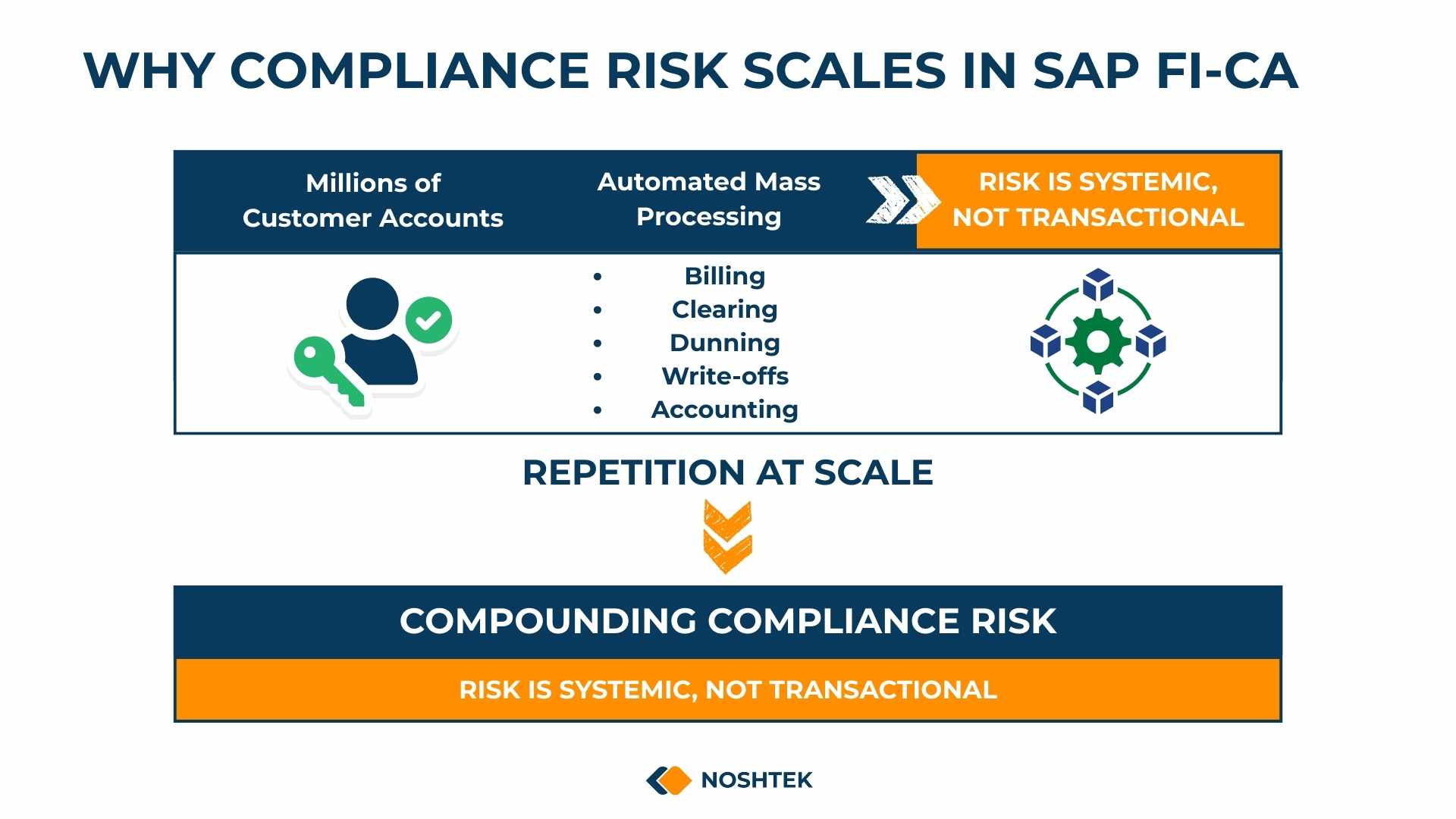
This scale introduces distinct compliance management risks:
- Configuration errors are amplified through automated clearing and posting runs
- Manual overrides bypass policy when controls are weak or poorly designed
- Excessive access increases fraud and audit exposure
- Data inconsistencies impact statutory and regulatory reporting
In FI-CA, risk does not stem from isolated transactions; it stems from system behavior repeated thousands or millions of times.
For CIOs, this is a system architecture and governance challenge.
For COOs, it is an execution, cash flow, and operational stability risk.
How SAP FI-CA Reduces Compliance Management Risk When Designed Correctly
When implemented with intent, SAP FI-CA reduces compliance management risk by embedding controls directly into transaction processing rather than relying on downstream detection.
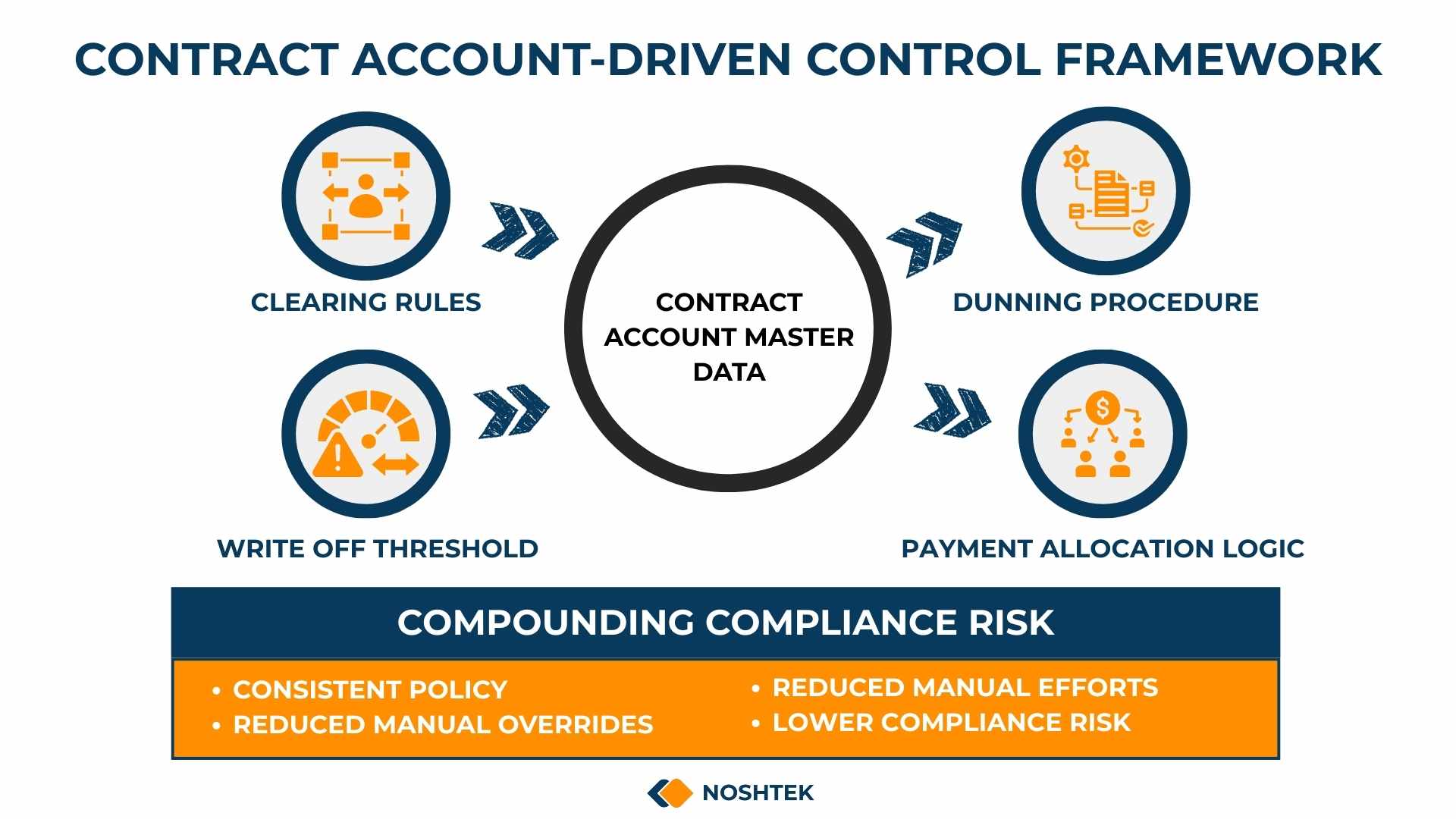
Contract Account–Driven Control Framework
In FI-CA, contract account master data governs critical behaviors, including:
- Clearing logic and clearing categories
- Dunning procedures and interest calculation
- Write-off eligibility and thresholds
- Payment allocation and posting rules
This ensures financial policies are applied consistently and automatically, reducing dependency on manual intervention and limiting policy deviations at scale.
Built-In Auditability and Traceability
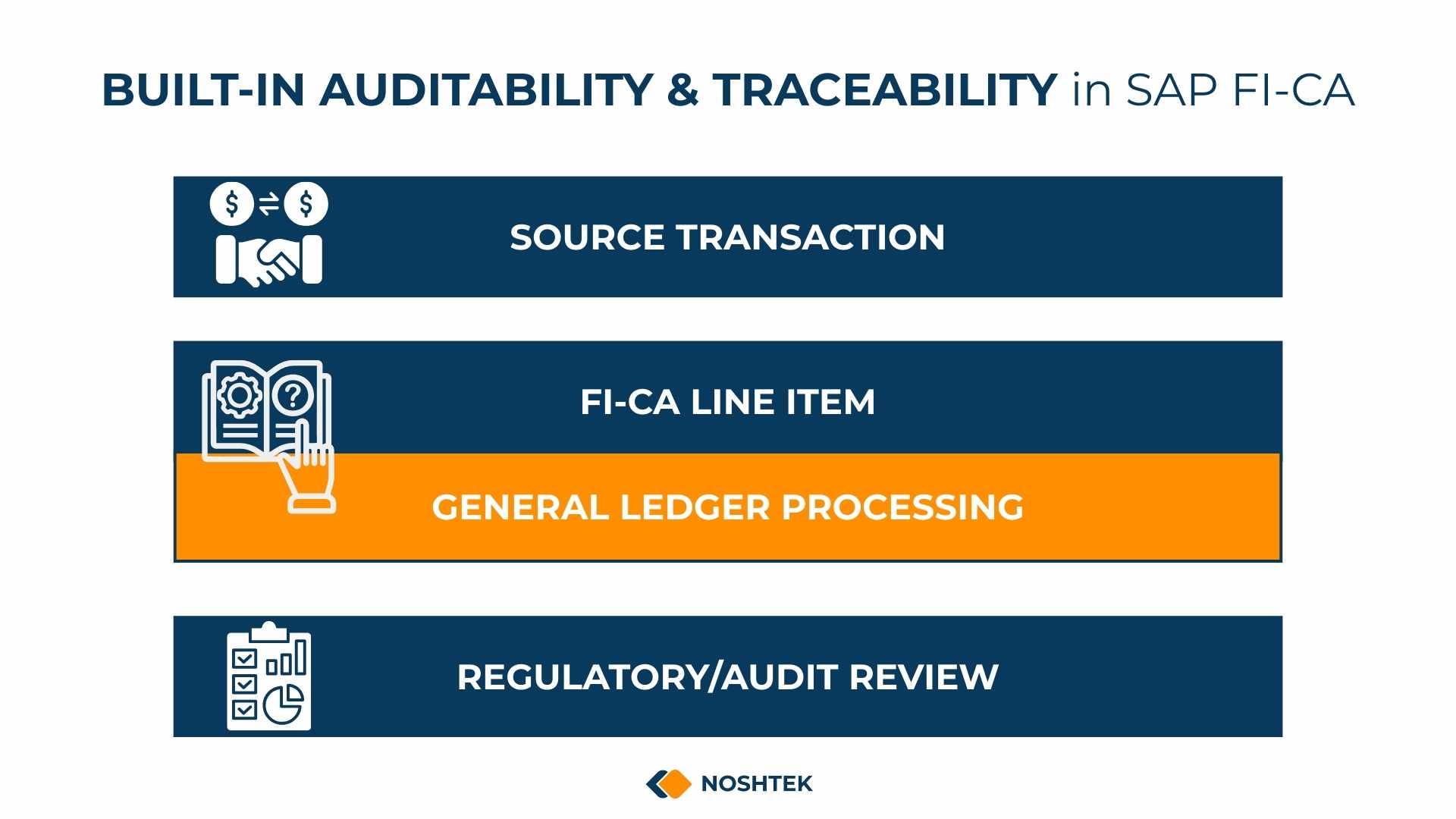
Every FI-CA transaction maintains:
- Detailed line-item history
- Complete document flow
- Clear linkage between source documents and the general ledger
This provides audit-ready transparency for regulators and internal audit teams while giving leadership confidence in financial data integrity.
Compliance-Ready Reporting and Governance Integration
FI-CA integrates with SAP’s broader compliance ecosystem, including:
- SAP Document and Reporting Compliance (DRC)
- Financial Compliance Management
- SAP GRC and Risk Management
This reduces compliance risk caused by mismatches between subledger data and statutory or regulatory reporting one of the most common failure points in high-volume finance environments.
Managing Financial and Operational Risk with SAP FI-CA
Beyond statutory compliance, FI-CA plays a direct role in enterprise risk management:
- Revenue recognition risk
IFRS-aligned processing reduces misstatement exposure in the general ledger.
- Credit and liquidity risk
Structured dunning and collections strategies improve DSO and cash-flow predictability.
- Bad debt and write-off risk
Controlled write-off variants prevent unauthorized adjustments and revenue leakage.
When integrated with SAP GRC, FI-CA can also trigger real-time alerts for high-risk events such as unusual posting volumes, access violations, or credit threshold breaches.
Common Compliance Management Risks in SAP FI-CA and How to Mitigate Them
Posting and Clearing Risk
What goes wrong: Incorrect clearing logic creates disputes, open items, and misstated receivables.
Impact: Increased DSO, audit findings, customer dissatisfaction.
What good looks like:
- Well-defined clearing control rules
- Restricted manual clearing rights
- Dual review for sensitive adjustments and mass clearing runs
Dunning and Collections Risk
What goes wrong: Missed or incorrect dunning impacts cash flow and customer trust.
Impact: Lower recovery rates, inconsistent customer treatment.
What good looks like:
- Standardized dunning procedures
- Simulation runs before execution
- Continuous monitoring of dunning logs and exceptions
Write-Off and Bad Debt Risk
What goes wrong: Excessive or unauthorized write-offs distort financial results.
Impact: Revenue leakage and audit exposure.
What good looks like:
- Write-off variants with amount and age thresholds
- Approval workflows for high-value write-offs
- Audit review of mass write-off activities
Access and Segregation of Duties (SoD) Risk
What goes wrong: Single users maintain master data, execute mass runs, and approve write-offs.
Impact: Fraud risk and recurring audit findings.
What good looks like:
- Role-based access design
- Segregation of sensitive FI-CA functions
- Continuous SoD monitoring via SAP GRC
Many FI-CA audit issues arise when compliance controls are added after go-live, rather than engineered into system design.
A CIO- and COO-Led Approach to FI-CA Compliance
Leading organizations treat FI-CA compliance as part of solution architecture, not a remediation exercise.
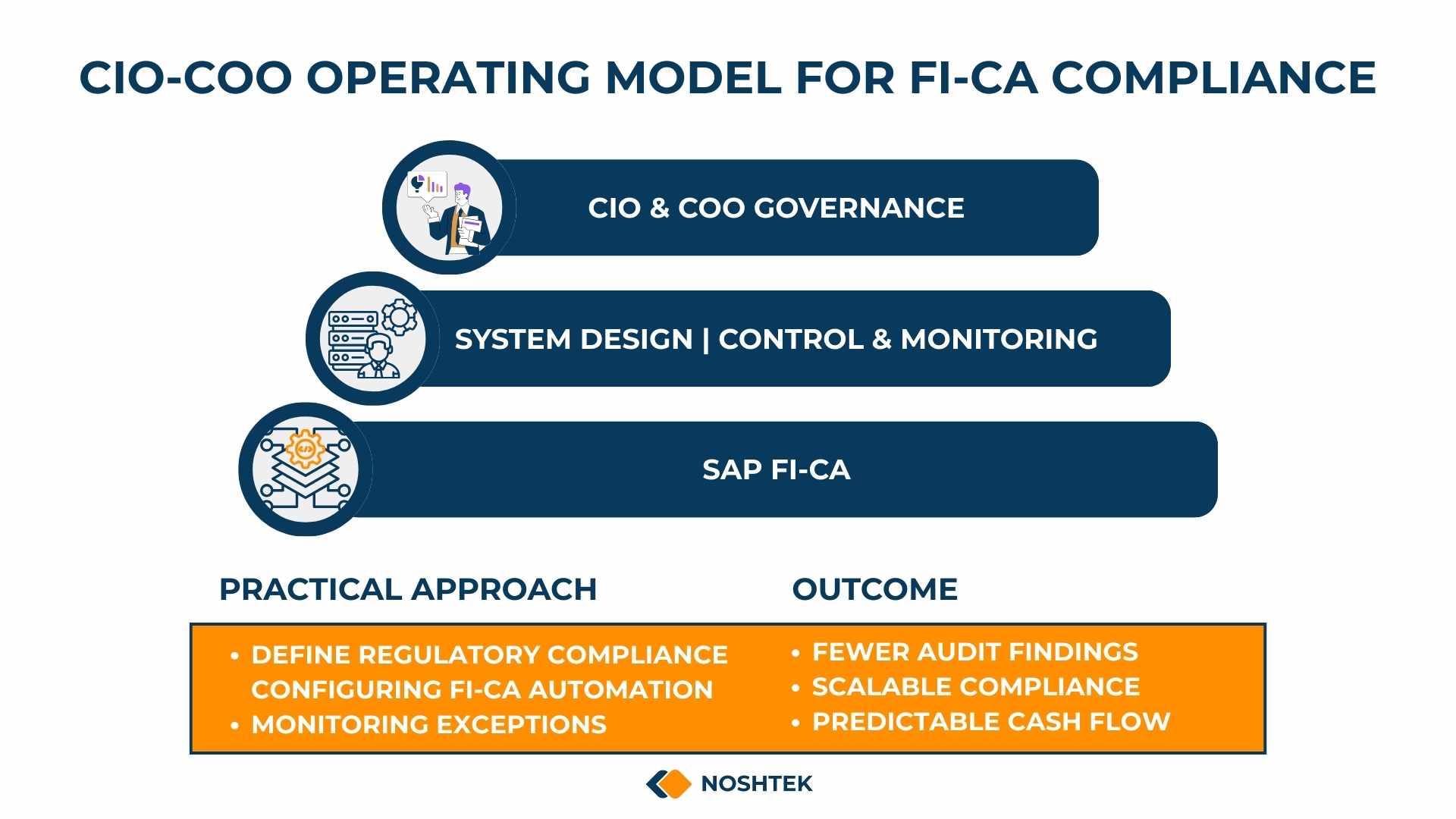
A practical approach includes:
- Defining regulatory and compliance requirements early
(IFRS, local tax laws, sector-specific regulations)
- Configuring FI-CA to enforce policy by default
- Integrating FI-CA with SAP GRC and DRC for automated control testing and reporting
- Monitoring exceptions, not just outcomes
Organizations that follow this approach typically see:
- Fewer recurring audit findings in receivables and revenue recognition
- Improved DSO and cash-forecast accuracy
- Reduced manual exception handling in collections and write-offs
How Noshtek Helps Reduce Compliance Management Risk in SAP FI-CA
Noshtek helps enterprises design compliance by designing FI-CA landscapes that support scale, audit readiness, and operational efficiency.
We partner with CIOs and COOs to:
- Embed compliance controls directly into FI-CA configuration
- Align FI-CA processes with internal control and audit frameworks
- Integrate FI-CA with SAP GRC, Process Control, and Document & Reporting Compliance
- Reduce revenue leakage and recurring audit findings in high-volume environments
Compliance management at risk cannot be eliminated, but it can be engineered, measured, and controlled.
Next step: Schedule a 60-minute FI-CA compliance and risk review to identify hidden exposure in your current design. Book a consultation now!
Frequently Asked Questions (FAQs)
What is compliance management risk in SAP FI-CA?
It refers to the risk of financial misstatements, regulatory non-compliance, audit findings, and revenue leakage caused by high-volume contract accounting processes such as billing, clearing, dunning, write-offs, and revenue recognition.
Why is SAP FI-CA considered high risk from a compliance perspective?
Because FI-CA processes millions of transactions automatically. Configuration gaps, weak access controls, or manual overrides can scale rapidly across the enterprise.
How does SAP FI-CA reduce compliance management risk?
By enforcing financial policies through configuration of contract account controls, rule-based clearing and write-offs, detailed audit trails, and integration with SAP GRC and compliance reporting tools.
When should enterprises reassess their FI-CA compliance design?
After mergers, regulatory changes, audit findings, or significant increases in transaction volume, any timescale or complexity changes.

Looking for expertise and excellent know-how in matters of insurance & banking?
Mithlesh Kumar Jha
Managing Partner - SAP FPSL (Insurance & Banking)Highly skilled and experienced SAP Solution Architect with over 20 years of expertise in SAP finance transformation and system implementation. Proficient in SAP S/4HANA Finance, IS-U, BRIM, FI-CA, PAPM, FPSL, and SAP Analytics Cloud (SAC). Adept at designing and delivering end-to-end SAP solutions that align with business goals, enhance financial performance, and ensure regulatory compliance with IFRS17, Solvency II, US GAAP, and LDTI. Strong technical proficiency in ABAP, HANA modeling, BTP, and system integration. Demonstrated ability to lead cross-functional teams, manage complex projects, and drive business process optimization through innovative and scalable SAP solutions.